ASPIC

envie a um amigo share this

Mutações somáticas no gene POLE no cancro colo-retal metastático

O cancro colo-retal (CCR) é uma das principais causas de morbilidade e mortalidade em todo o mundo. Os fatores etiológicos e mecanismos patogénicos subjacentes ao desenvolvimento do CCR são complexos e heterogéneos. A maioria dos casos de CCR ocorrem esporadicamente, surgindo através da acumulação sequencial de várias alterações genéticas e/ou epigenéticas envolvendo genes que regulam o crescimento e diferenciação celular. Apesar dos avanços na compreensão das vias de carcinogénese do CCR esporádico, o significado destas alterações ainda não está completamente compreendido.

Spirotriazoline oxindoles: A novel chemical scaffold with in vitro anticancer properties

In this publication we report on the design and synthesis of a library of twenty-six spirotriazoline oxindoles and their in vitro evaluation as potential anticancer agents. The antiproliferative activity of the synthesized compounds was assessed against four different cancer cell lines (HCT-116 p53 (+/+), HCT-116 p53 (-/-), MCF-7, MDA-MB-231). Four spirotriazoline oxindoles showed selectivity against the four cancer cell lines tested over the non-cancer derived HEK 293T cell line.

Novos compostos espiro com propriedades anti-cancerígenas in vitro

O cancro da mama é o tipo de cancro mais comum entre as mulheres, sendo a principal causa de morte por cancro nos USA em mulheres entre os 20 e os 59 anos. Em particular, os carcinomas de mama triplo negativos são os mais agressivos e mortais, sendo extremamente importante o desenvolvimento de novos fármacos que atuem nestes subtipos de cancro da mama.

Disruption of mitochondrial function as mechanism for anti-cancer activity of a novel mitochondriotropic menadione derivative

Authors and Affiliations:

José Teixeira1,2, Ricardo Amorim1, Katia Santos2, Pedro Soares1, Sandipan Datta3, Gino A. Cortopassi3, Teresa L. Serafim2, Vilma A. Sardão2, Jorge Garrido1,4, Fernanda Borges1, Paulo J. Oliveira2

CIQUP/Department of Chemistry and Biochemistry, Faculty of Sciences, University of Porto, Porto, Portugal

Novo derivado da menadiona com efeitos anti-tumorais em modelo celular de cancro do pulmão

Um trabalho conjunto de equipas do CNC – Centro de Neurociências e Biologia Celular, Universidade de Coimbra, da FCUP-Faculdade de Ciências da Universidade do Porto, do Instituto Politécnico do Porto, e da Universidade da Califórnia em Davis, E.U.A. mostrou que uma molécula derivada da vitamina K3 (MitoK3), modificada para acumulação específica numa estrutura celular chamada mitocôndria, foi capaz de tornar células de cancro do pulmão mais susceptíveis aos efeitos de agentes anticancerígenos.

Early GalNAc O-Glycosylation: Pushing the Tumor Boundaries

Cellular glycosylation occurring during cancer development and progression represent key features of tumor cell malignant behavior. In this publication, the authors preview and discuss the findings of Nguyen et al. (Cancer Cell. 2017 Nov 13;32(5):639-653) who identified a molecular mechanism in which the relocation of a glycosyltransferase mediating protein O-glycosylation initiation, from the Golgi to endoplasmic reticulum, leads to aberrant glycosylation.

Early GalNAc O-Glycosylation: Pushing the Tumor Boundaries

Cellular glycosylation occurring during cancer development and progression represent key features of tumor cell malignant behavior. In this publication, the authors preview and discuss the findings of Nguyen et al. (Cancer Cell. 2017 Nov 13;32(5):639-653) who identified a molecular mechanism in which the relocation of a glycosyltransferase mediating protein O-glycosylation initiation, from the Golgi to endoplasmic reticulum, leads to aberrant glycosylation.

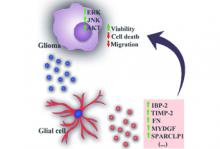
Crosstalk between glial and glioblastoma cells triggers the "go-or-grow" phenotype of tumor cells

Authors and Affiliations:

Ana Isabel Oliveira1,2, Sandra I. Anjo3,4, Joana Vieira de Castro1,2, Sofia C. Serra1,2, António J. Salgado1,2, Bruno Manadas3#, Bruno M. Costa1,2#

1Life and Health Sciences Research Institute (ICVS), School of Medicine, University of Minho, Braga, Portugal.

2ICVS/3B’s - PT Government Associate Laboratory, Braga/Guimarães, University of Minho, Braga, Portugal.

Células malignas de glioblastoma interagem com células normais gliais vizinhas, modulando o seu secretoma para benefício próprio

O glioblastoma (GBM) é o tumor mais maligno do cérebro e o seu prognóstico é muito reservado. Estudos recentes demonstraram que o microambiente tumoral pode ter um papel importante na regulação do crescimento dos tumores, através da interação com as células tumorais. Nesse contexto, investigámos de que modo as células de GBM são capazes de interagir com as células não-tumorais de glia, e como essa interação poderia influenciar de volta o fenótipo maligno das células de GBM.

KRAS oncogenic signaling extends beyond cancer cells to orchestrate the microenvironment

This review covers the findings related to alterations in the tumor microenvironment induced by KRAS activation in cancer cells, bringing to attention new mechanisms of KRAS-induced tumor progression which may have a great impact on the design of new therapies that target cancer cells by abrogating their interaction with the tumor microenvironment.


Authors and Affiliations: