Vânia Gonçalves1,2, Andreia Henriques1,2, Joana Pereira1,2, Ana Neves Costa3, Mary Pat Moyer4, Luís Ferreira Moita3, Margarida Gama-Carvalho2,5, Paulo Matos1,2 and Peter Jordan1,2
1Department of Human Genetics, National Health Institute Dr. Ricardo Jorge, 1649-016 Lisbon, Portugal
2BioFIG–Centre for Biodiversity, Functional and Integrative Genomics, University of Lisbon, 1749-016 Lisbon, Portugal
Os nossos genes podem gerar mais do que uma proteína, e desta forma dar origem a um proteoma específico em diferentes tecidos, mas igualmente em tumores durante o seu desenvolvimento. É através do processo de splicing alternativo que os mesmos genes podem expressar proteínas variantes que dão origem a estes proteomas específicos, o que pode ocorrer em mais de 90% dos genes humanos. De um modo geral, sabe-se que a expressão de cada variante é regulada por uma combinação específica de factores de splicing no núcleo das células.
Nuno Bernardes1,2, Ana Sofia Ribeiro2, Sofia Abreu1, André F Vieira2, Laura Carreto3, Manuel Santos3, Raquel Seruca2, Joana Paredes2 and Arsenio M Fialho1 1Institute for Biotechnology and Bioengineering, Center for Biological and Chemical Engineering, Instituto Superior Técnico, Lisbon, Portugal;
2Institute of Molecular Pathology and Immunology of the University of Porto (IPATIMUP), Porto, Portugal;
O trabalho intitulado «High-throughput molecular profiling of a P-cadherin overexpressing breast cancer model reveals new targets for the anti-cancer bacterial protein azurin» resulta de uma investigação em parceria entre o IBB/IST e o IPATIMUP. Pretende-se contribuir para o esclarecimento acerca das propriedades anticancerígenas de uma proteína de origem bacteriana designada azurina. Esta proteína, solúvel e de baixo peso molecular (14 kDa) é sintetizada pela bactéria Pseudomonas aeruginosa.
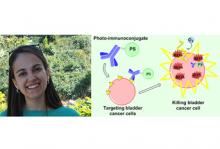
Photodynamic therapy (PDT) is a promising method, which has been studied and applied to improve the treatment of several tumour types. PDT combines molecular oxygen, light and a photosensitizer (PS) to generate cytotoxic reactions in cancer cells. The potential of PSs conjugated with biomolecules which will be recognized by antigens or receptors overexpressed in cancer cells prompted us to synthesize and to validate the photodynamic activity of a porphyrin conjugated with human and bovine serum albumins, and the monoclonal antibody anti-CD104.
A terapia fotodinâmica (PDT) é uma metodologia emergente no tratamento de diversas doenças oncológicas, tendo por base o uso de oxigénio, luz e um fotossensibilizador (PS) para gerar reações citotóxicas no tecido tumoral. Reconhecendo a potencialidade de PSs conjugados com diferentes biomoléculas para serem reconhecidos especificamente por antigénios ou recetores com expressão aumentada nas células tumorais, este estudo pretendeu sintetizar e avaliar o potencial fotodinâmico de uma porfirina conjugada com a albumina humana ou bovina, ou com o anticorpo monoclonal anti-CD104.
Luís Lima 1,2,3,4 and Daniela Oliveira 1; Ana Tavares 1,5; Teresina Amaro 6; Ricardo Cruz 7; Maria J. Oliveira 8,9,10; José A. Ferreira 1,11 and Lúcio Santos 1,12,13.
1 Experimental Pathology and Therapeutics Group, Portuguese Institute of Oncology, Porto, Portugal
2 ICBAS, Abel Salazar Biomedical Sciences Institute, University of Porto, Porto, Portugal