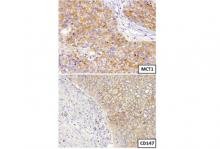
Little is known about the metabolic adaptations that alter the tumour microenvironment and thus contribute to chemoresistance in urothelial bladder cancer (UBC). Here we describe that CD147 and MCT1 overexpression associates with UBC aggressiveness. Moreover, platinum-treated patients with MCT1 and CD147 positive tumours have worse prognosis. CD147 depletion reduces MCTs expression and improves cisplatin response in UBC cells. Our results provide novel insights for the involvement of CD147 and MCTs in UBC progression and chemoresistance.
As adaptações metabólicas que alteram o microambiente tumoral e contribuem para a quimio-resistência no carcinoma urotelial da bexiga (CUB) permanecem por clarificar. O nosso grupo de investigação descreve, no presente trabalho, a associação entre o aumento de expressão de CD147 e MCT1 e a agressividade tumoral. O perfil duplamente positivo CD147/MCT1 discriminou um subgrupo de doentes com prognóstico adverso entre um grupo tratado com quimioterapia à base de compostos de platina.
Ana Vanessa Nascimento a,b, Amit Singh c, Hassan Bousbaa a,d, Domingos Ferreira b, Bruno Sarmento a,e, Mansoor M. Amiji c,
a CESPU, Instituto de Investigação e Formação Avançada em Ciências e Tecnologias da Saúde, IINFACTS, Rua Central de Gandra 1317, 4585-116 Gandra PRD, Portugal
b Laboratory of Pharmaceutical Technology, Faculty of Pharmacy, University of Porto, Portugal
Trabalho de investigação de grupo português, em parceria com grupo da Northeastern University de Boston, Estados Unidos, permitiu desenvolver um sistema de base nanotecnológica, dirigida especificamente a células cancerígenas, com o objetivo de entregar fármacos com a capacidade de silenciar proteínas envolvidas na mitose celular (RNA de interferência) e reduzir em quase 100% os níveis de expressão da proteína. Esta estratégia terapêutica poderá resultar na morte seletiva de células cancerígenas, e em avanços significativos no tratamento do cancro.
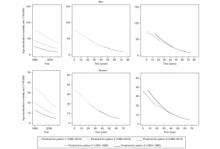
Three patterns for the variation in stomach cancer mortality worldwide were identified, allowing the creation of a model with three different stages that develop sequentially through a period of approximately 70 years, which may serve as a basis for predictions of the future trend.
Authors and Affiliations:
Bárbara Peleteiroa,b, Milton Severoa,b, Carlo La Vecchiac,d, Nuno Luneta,b
Foram identificados três padrões de variação na mortalidade por cancro do estômago a nível mundial, permitindo a criação de um modelo que mostra a sequência de três fases correspondente a um período de aproximadamente 70 anos, o qual pode servir de base para projeções da tendência no futuro.
Autores e Afiliações:
Bárbara Peleteiroa,b, Milton Severoa,b, Carlo La Vecchiac,d, Nuno Luneta,b
In this work we have assessed the expression profile of two transcription factors, SOX2 and CDX2 in intestinal metaplasia (IM) and dysplasia, two lesions that precede gastric cancer onset. Our results provide a molecular basis to understand the heterogeneity of metaplastic lesions and favor the hypothesis that dysplasia arises from IM. These results have clinical implications since they advise a closer surveillance of patients presenting with IM.
Neste trabalho caracterizámos o padrão de expressão de dois fatores de transcrição, SOX2 e CDX2 na metaplasia intestinal (MI) e displasia gástricas, duas lesões que precedem o desenvolvimento do cancro gástrico. Os nossos resultados providenciam uma base molecular para perceber a heterogeneidade das lesões metaplásicas e favorecem a hipótese de que a displasia surge a partir da MI. Estes resultados têm implicações clinicas uma vez que aconselham uma vigilância mais apertada de pacientes com MI.
The American Association for Cancer Research (AACR) published the AACR Cancer Progress Report 2014 and the focus is on how scientists have made research count for patients. As the fourth report in this series, this year's Cancer Progress Report highlights the many advances and breakthroughs in cancer treatment and emphasizes the need for continued investment in cancer research.
The American Association for Cancer Research (AACR) published the AACR Cancer Progress Report 2014 and the focus is on how scientists have made research count for patients. As the fourth report in this series, this year's Cancer Progress Report highlights the many advances and breakthroughs in cancer treatment and emphasizes the need for continued investment in cancer research.