ASPIC

send to a friend share this

Conversation with James Allison from the JCI series «Conversations with Giants in Medicine»

We decided to republish in ASPIC's website the interview below:


Interview with James Allison of the MD Anderson Cancer Center, who has made key discoveries on the regulation of T cell activation and modulation. He was awarded the 2015 Lasker DeBakey Clinical Medical Research Award in honor of his discovery and subsequent development of CTLA-4–targeted monoclonal antibody therapy to unleash the immune response to cancer.


See the interview here: http://www.jci.org/videos/104

The metabolic reprogramming of adult adrenocortical tumors is associated with patient’s prognosis

Most tumors show an increase in glucose consumption, which is metabolized resulting in lactic acid production. Consequently, the lactate formed is transported out of the tumor cells by a protein complex formed by monocarboxylate transporters (MCT) and CD147. The hyperglicolytic phenotype is characterized by the expression of the glucose transporter GLUT1, the pH regulator CAIX and lactate transporters (MCT1 and MCT4), and is associated with tumor progression and aggressiveness.

A reprogramação metabólica de tumores adrenais está associada ao prognóstico dos pacientes

A maioria dos tumores apresenta um aumento no consumo de glucose, a qual é metabolizada resultando na produção de ácido láctico. Consequentemente, o ácido láctico formado é transportado para fora das células tumorais por um complexo de moléculas formado pelos transportadores de monocarboxilatos (MCTs) e a CD147. O fenótipo hiperglicolítico caracteriza-se pela expressão do transportador de glucose GLUT1, do regulador de pH CAIX e de transportadores de lactato (MCT1 e MCT4), e está relacionado com a progressão e agressividade tumoral.

Effects of X radiation on Lung Cancer Cell Line - The interplay between oxidative stress and P53 levels

Ionizing radiation presents itself in the form of particles (alpha particles, beta particles, protons or neutrons) or electromagnetic radiation (gamma rays and X-rays) with characteristic ionizing power and penetration. Radiotherapy is an essential tool in the treatment of cancer. We can consider various forms of radiation such as external beam radiotherapy, brachytherapy and metabolic radiotherapy. When treating cancer with ionizing radiation all cells within the irradiation volume are more or less exposed.

Efeitos da radiação X em linhas celulares de cancro do pulmão - A interação entre stresse oxidativo e os níveis de P53

A radiação ionizante apresenta-se sob a forma de partículas (partículas alfa, partículas beta, protões ou neutrões) ou de radiação eletromagnética (raios gama e os raios-X) com poder ionizante e de penetração caraterísticos. A radioterapia é uma ferramenta essencial no tratamento do cancro. Podemos considerar várias formas de radioterapia como a telerradioterapia, a braquiterapia e a radioterapia metabólica. No tratamento do cancro com recurso à radiação ionizante, todas as células que se encontrem dentro do volume irradiado, são mais ou menos expostas.

Nucleolin overexpression in cancer stem cells enables targeted intracellular delivery of synergistic drug combination

Breast cancer stem cells (CSC) are believed to play a relevant role in tumor growth and relapse, metastization and active evasion to standard chemotherapy, thus representing an important tumor target. The objective of this work was to assess whether nucleolin was a receptor expressed in both breast cancer stem cells and non-stem cancer cells and whether it could be exploited to target nanoparticles-encapsulating drug combinations.

A sobreexpressão de nucleolina em células cancerígenas estaminais permite a entrega de combinação sinergística de fármacos

Em cancro da mama, pensa-se que existem as denominadas células estaminais cancerígenas (CEC), e que estas desempenham um papel relevante no crescimento tumoral, metastização, recorrência e resistência ativa à quimioterapia. Tais características fazem das CEC alvos terapêuticos relevantes.

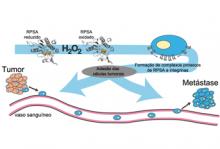
RPSA was identified for the first time as a hydrogen peroxide sensor that regulates adhesion of tumor cells

Hydrogen peroxide (H2O2) is a well-known antiseptic used in our homes since the 1920s. But did you know that our cells produce this molecule and that at low concentrations H2O2 instructs our cells to do different things, acting as a signaling molecule? In fact, H2O2 may oxidize several cellular components including proteins, altering their function. Healthy cells use H2O2 to regulate several of their behaviors, including proliferation, migration, or even cell-to-cell communication.

RPSA foi pela primeira vez identificada como um sensor de peróxido de hidrogénio que regula a adesão das células tumorais

O peróxido de hidrogénio (H2O2) é um anti-séptico conhecido e sobejamente utilizado desde 1920. No entanto, esta molécula é também produzida pelas células do nosso organismo e atua como molécula sinalizadora, instruindo as nossas células a alterar as suas funções. As funções celulares reguladas pelo H2O2 incluem a proliferação e a migração, que são particularmente relevantes no desenvolvimento do cancro.

15th St Gallen International Breast Cancer Conference Primary Therapy of Early Breast Cancer

Vienna, Austria


15 - 18 March, 2017


See more informations here: http://www.oncoconferences.ch/dynasite.cfm?dsmid=500295