ASPIC

envie a um amigo share this

Absence of Telomerase Leads to Immune Response and Tumor Regression in Zebrafish

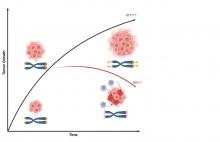
Lopes-Bastos et al. report that melanoma in zebrafish initiates without telomerase (or ALT) activation. However, in late progression, telomerase becomes essential for sustained tumor growth. Tumors that fail to re-activate telomerase slow down growth and even regress. This occurs due to tumor-autonomous (genomic instability) and non-tumor-autonomous (immune response) mechanisms.

Absence of Telomerase Leads to Immune Response and Tumor Regression in Zebrafish

Lopes-Bastos et al. report that melanoma in zebrafish initiates without telomerase (or ALT) activation. However, in late progression, telomerase becomes essential for sustained tumor growth. Tumors that fail to re-activate telomerase slow down growth and even regress. This occurs due to tumor-autonomous (genomic instability) and non-tumor-autonomous (immune response) mechanisms.

22º Congresso Nacional de Oncologia

Forum Braga - Braga


26-28 November, 2025


See more information here: https://cno.sponcologia.pt/2025/home.php?lg=1

22º Congresso Nacional de Oncologia

Forum Braga - Braga


26-28 November, 2025


See more information here: https://cno.sponcologia.pt/2025/home.php?lg=1

The EACR Conference on Cancer Metabolism

The EACR Conference on Cancer Metabolism

7th ASPIC International Congress

IPO-Porto Auditorium, Porto, Portugal


25-26 June, 2026


See more information here: https://7thcongress.aspic.pt/

7th ASPIC International Congress

IPO-Porto Auditorium, Porto, Portugal


25-26 June, 2026


See more information here: https://7thcongress.aspic.pt/

i3S lidera estudo que redefine o risco de cancro e as diretrizes de testes para portadores do gene CTNNA1

Um estudo internacional envolvendo 56 investigadores e clínicos de nove países, liderado pela cientista Carla Oliveira, do Instituto de Investigação e Inovação em Saúde da Universidade do Porto (i3S), e publicado na prestigiada revista GUT, definiu novas causas de risco genético de cancro gástrico e mamário e critérios clínicos para os identificar.

Landmark Study Redefines Cancer Risk and Testing Guidelines for CTNNA1 Gene Carriers

A groundbreaking international study has provided critical insights into the role of CTNNA1 gene variants in hereditary diffuse gastric cancer (HDGC), revealing new associations with cancer risk and paving the way for improved genetic testing and clinical management of affected individuals.

The study involved 56 researchers and clinicians from 9 countries, from the European and American continents, led by an i3S team in Porto.