
Associação Portuguesa de Investigação em Cancro
The quantitative architecture of centromeric chromatin
The quantitative architecture of centromeric chromatin
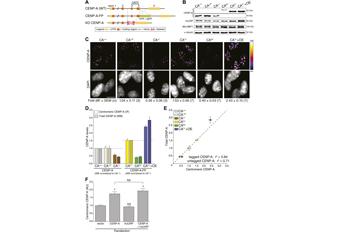
Centromeres are essential for proper cell division. During mitosis, a transient structure called the kinetochore is assembled onto centromeric chromatin, which mediates the interaction between DNA and the mitotic spindle. Intriguingly, although centromeres are directly embedded in chromatin, specific DNA sequences are neither necessary nor sufficient for centromere function. This is best exemplified by the rare occurrence, within the human population, of neocentromeres: functional centromeres that have repositioned to atypical loci on the chromosome. Rather than centromeric sequences, the primary candidate for epigenetic specification of centromeres is the histone variant CENP-A, which replaces canonical H3 in centromeric nucleosomes. CENP-A chromatin is sufficient for recruitment of the downstream centromere and kinetochore complexes . In addition, CENP-A is stably transmitted at centromeres during mitotic and meiotic divisions, and its assembly is tightly cell cycle controlled. Importantly, targeting of this protein to an ectopic site of the genome is sufficient to initiate an epigenetic feedback loop, recruiting more CENP-A to this site. However, little is known about the quantity of CENP-A present at centromeres, despite this being an essential parameter for a functional understanding of both centromeric architecture and epigenetic inheritance. Here, we use multiple, independent approaches to determine the absolute copy number of CENP-A at centromeres. In addition, we provide novel insights in the mechanisms of centromere size control.
Authors and Affiliations:
Dani L Bodor, João F Mata, Mikhail Sergeev, Ana Filipa David, Kevan J Salimian, Tanya Panchenko, Don W Cleveland, Ben E Black, Jagesh V Shah, Lars ET Jansen
Instituto Gulbenkian de Ciência, Portugal; Harvard Medical School, United States; Brigham and Women's Hospital, United States; University of Pennsylvania, United States; University of California, San Diego, United States
Abstract:
The centromere, responsible for chromosome segregation during mitosis, is epigenetically defined by CENP-A containing chromatin. The amount of centromeric CENP-A has direct implications for both the architecture and epigenetic inheritance of centromeres. Using complementary strategies, we determined that typical human centromeres contain ∼400 molecules of CENP-A, which is controlled by a mass-action mechanism. This number, despite representing only ∼4% of all centromeric nucleosomes, forms a ∼50-fold enrichment to the overall genome. In addition, although pre-assembled CENP-A is randomly segregated during cell division, this amount of CENP-A is sufficient to prevent stochastic loss of centromere function and identity. Finally, we produced a statistical map of CENP-A occupancy at a human neocentromere and identified nucleosome positions that feature CENP-A in a majority of cells. In summary, we present a quantitative view of the centromere that provides a mechanistic framework for both robust epigenetic inheritance of centromeres and the paucity of neocentromere formation. - See more at: http://elifesciences.org/content/3/e02137#sthash.Ec70AUMR.dpuf
Journal: eLife