ASPIC

send to a friend share this

Reunião científica - CIMAGO

Anfiteatro 2 do Centro Hospitalar e Universitário de Coimbra, Coimbra, Portugal


26 - 27 January, 2017

See more informations here: http://www.uc.pt/fmuc/cimago/reunioescientificas/reuniao_cientifica_2017


Conferência «Risco Familiar de Cancro»

Fundação Calouste Gulbenkian, Lisboa, Portugal


22 September, 2017


See more informations here: https://www.ligacontracancro.pt/risco-familiar-de-cancro/

Conferência «Risco Familiar de Cancro»

Fundação Calouste Gulbenkian, Lisboa, Portugal


22 September, 2017


See more informations here: https://www.ligacontracancro.pt/risco-familiar-de-cancro/

Prostate cancer prognosis defined by the combined analysis of 8q, PTEN and ERG

Prostate cancer (PCa) is the second most frequently diagnosed non-skin cancer in men worldwide and the fifth cause of cancer-related deaths. The introduction of serum prostate-specific antigen (PSA) analysis constituted an important clinical tool for early PCa detection and disease monitoring, but this test has modest sensitivity and specificity and has limited prognostic value. This shows that there is an unmet need of novel diagnostic and prognostic markers for PCa clinical management.

Prognóstico do cancro da próstata definido pela análise combinada do 8q, PTEN e ERG

O cancro de próstata (CaP) é o segundo tipo de cancro mais diagnosticado em homens e a quinta causa de morte por cancro em todo o mundo. A introdução da análise do PSA constituiu uma importante ferramenta clínica para detecção precoce de CaP e monitorização da doença, mas este teste tem uma sensibilidade e especificidade baixas e o seu valor de prognóstico é limitado. Isto mostra que existe uma necessidade crescente de novos marcadores de diagnóstico e prognóstico mais fidedignos para a gestão clínica desta doença.

Discovery of a Novel, Isothiazolonaphthoquinone-Based Small Molecule Activator of FOXO Nuclear-Cytoplasmic Shuttling

Authors and Affiliations:

Bastien Cautain1, Francisco Castillo1, Loana Musso2, Bibiana I. Ferreira3,4, Nuria de Pedro1, Lorena Rodriguez Quesada1, Susana Machado3, Francisca Vicente1, Sabrina Dallavalle2, Wolfgang Link3,4

1 Fundacion MEDINA, Parque Tecnológico Ciencias de la Salud, Granada, Spain, 

Investigadores do CBMR descobrem composto químico que pode ser usado como arma nos tumores humanos

Uma equipa de investigadores do Centro de Investigação em Biomedicina, liderada por Wolfgang Link e composta por investigadores nacionais e internacionais, entre os quais Bibiana Ferreira e Susana Machado, também investigadoras do CBMR, acaba de publicar um inovador artigo científico na revista científica PLOS ONE, uma das mais conceituadas revistas internacionais de acesso aberto na área das ciências e da medicina.


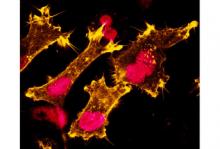
The EACR image of the month is from a portuguese PhD student

The EACR November image of the Month winner was sent by Patrícia Manuela Ribeiro Pereira, PhD student at the University of Aveiro, Portugal and the Faculty of Medicine at the University of Coimbra, Portugal. The image shows increased F-actin staining in human bladder cancer cells after photodynamic therapy. After plating the cancer cells, they were incubated with a photosensitizer compound and then irradiated. The cells were then stained with markers of F-actin (yellow) and nucleus (pink). F-actin, a component of cytoskeleton, has key roles in cell morphology and membrane integrity.

Total tumor load assessed by one-step nucleic acid amplification assay as an intraoperative predictor for non-sentinel lymph node metastasis in breast cancer

Authors and Affiliations:

Celso Nabais a, Joana Figueiredo a, Paulina Lopes a, Manuela Martins b, António Araújo a

a Department of Surgery, Centro Hospitalar Lisboa Central, Portugal

b Department of Pathology, Centro Hospitalar Lisboa Central, Portugal


Abstract:

Novel peptides for individualized therapy of claudin-low breast cancers

What are the main drawbacks in breast cancer early detection?

What is the breast cancer subtype with the worst clinical outcome?

Why are novel cellular targets important for targeted therapies?