immune response

envie a um amigo share this

Absence of Telomerase Leads to Immune Response and Tumor Regression in Zebrafish

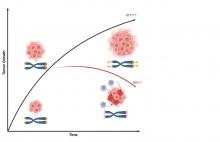
Lopes-Bastos et al. report that melanoma in zebrafish initiates without telomerase (or ALT) activation. However, in late progression, telomerase becomes essential for sustained tumor growth. Tumors that fail to re-activate telomerase slow down growth and even regress. This occurs due to tumor-autonomous (genomic instability) and non-tumor-autonomous (immune response) mechanisms.

Absence of Telomerase Leads to Immune Response and Tumor Regression in Zebrafish

Lopes-Bastos et al. report that melanoma in zebrafish initiates without telomerase (or ALT) activation. However, in late progression, telomerase becomes essential for sustained tumor growth. Tumors that fail to re-activate telomerase slow down growth and even regress. This occurs due to tumor-autonomous (genomic instability) and non-tumor-autonomous (immune response) mechanisms.

RANK pathway inhibition sensitizes triple-negative breast cancer to CDK4/6 inhibitors and enhances immune response

This study, led by Sandra Casimiro and Luis Costa from the Oncology Translational Lab at GIMM CARE, part of the GIMM Foundation – Gulbenkian Institute for Molecular Medicine, demonstrates the potential efficacy of a novel therapeutic strategy for triple-negative breast cancer (TNBC) — an aggressive form of breast cancer for which treatment options are largely limited to chemotherapy.